
Bounty
Curated by Sadaf Padder
January 28 – February 28, 2026
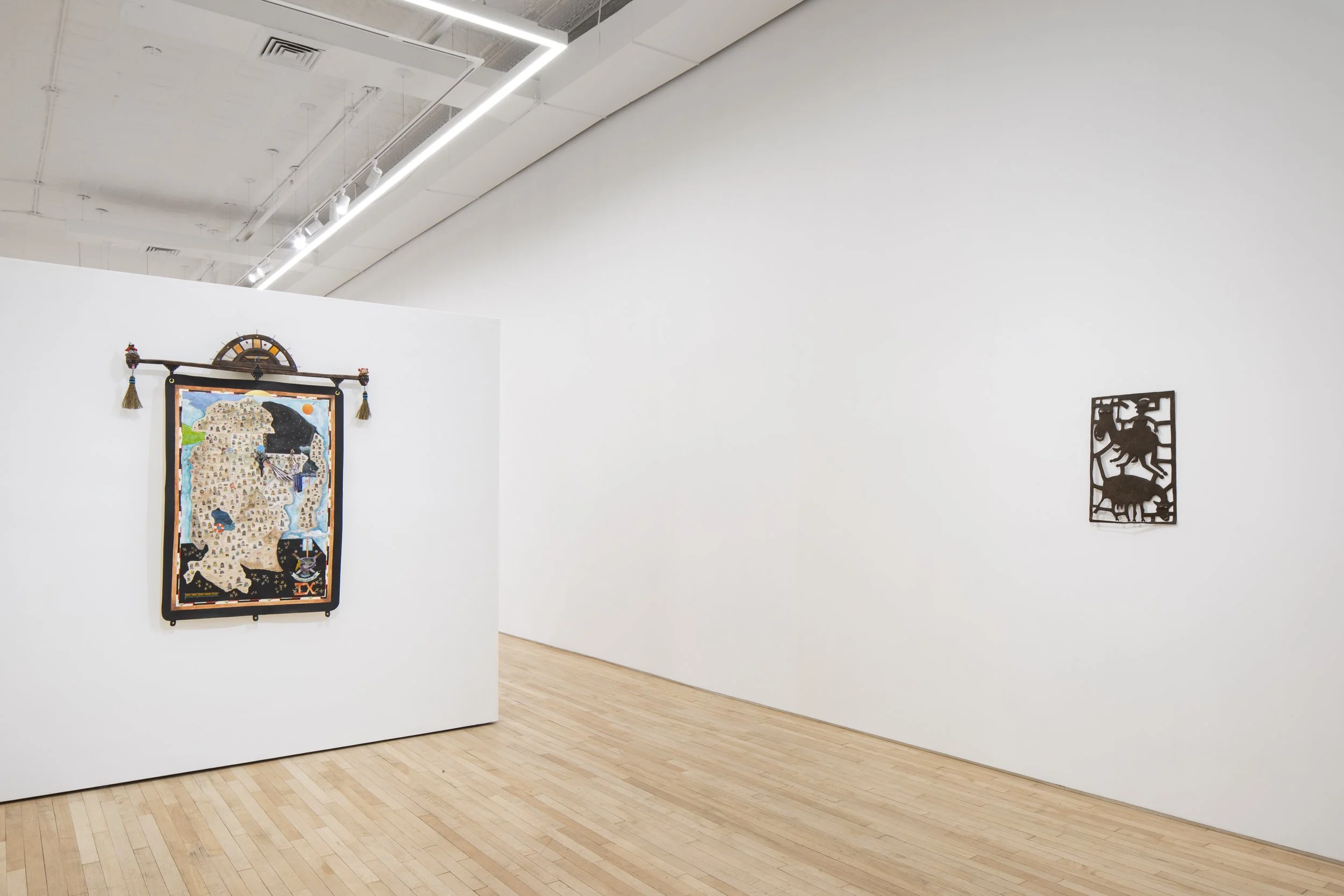
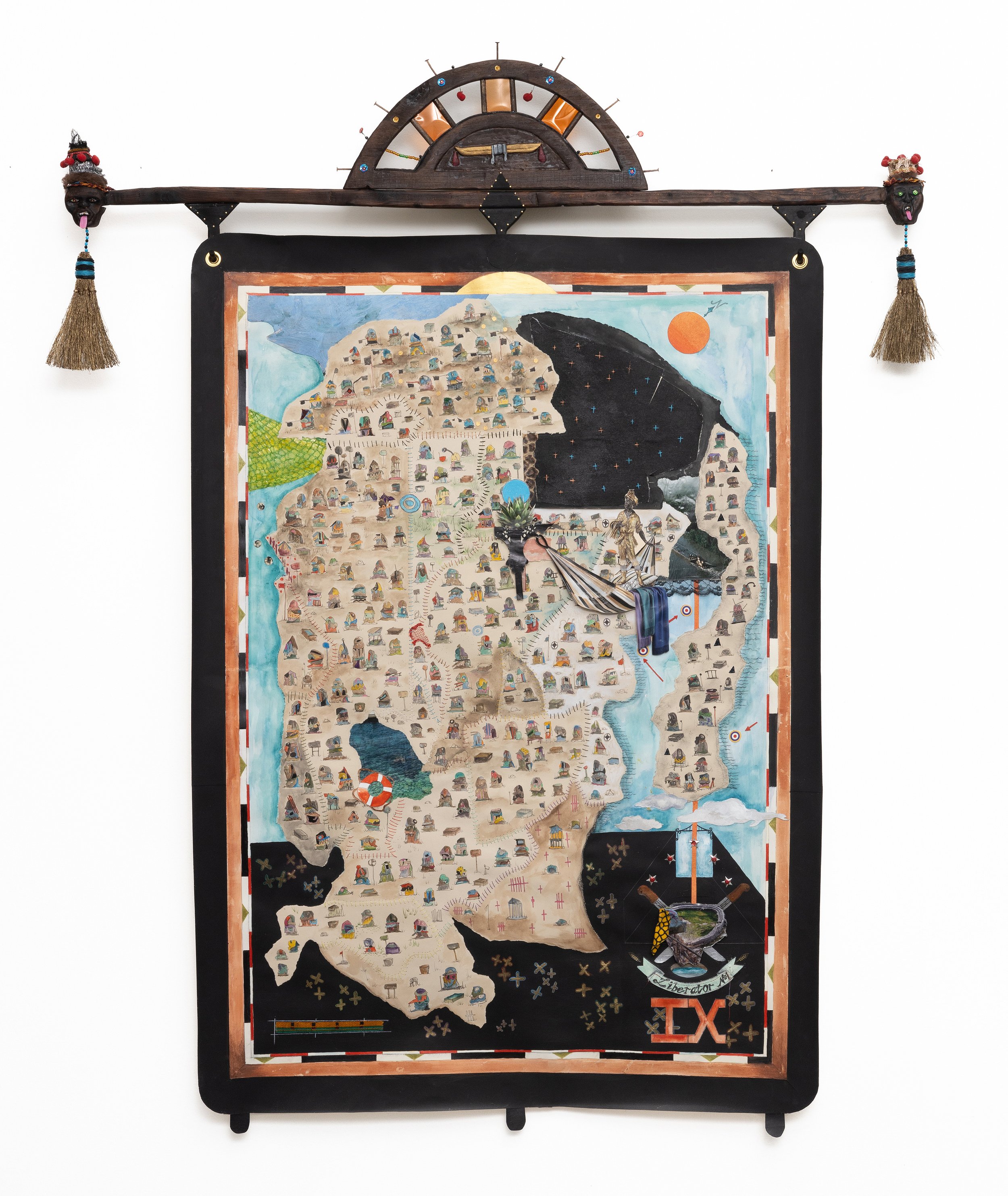
Nyugen E. Smith, Bundlehouse Borderlines No. 9 (Liberator No. 1), 2023, Watercolor, pen and ink, acrylic, colored pencil, diaspora soil, plastic net, sequins, fabric, thread, graphite, oil pastel, and collage on paper, hand-carved support (wood, fabric, beads, fiber, plastic nails, acrylic, wool, and paper), 47 x 34 in.
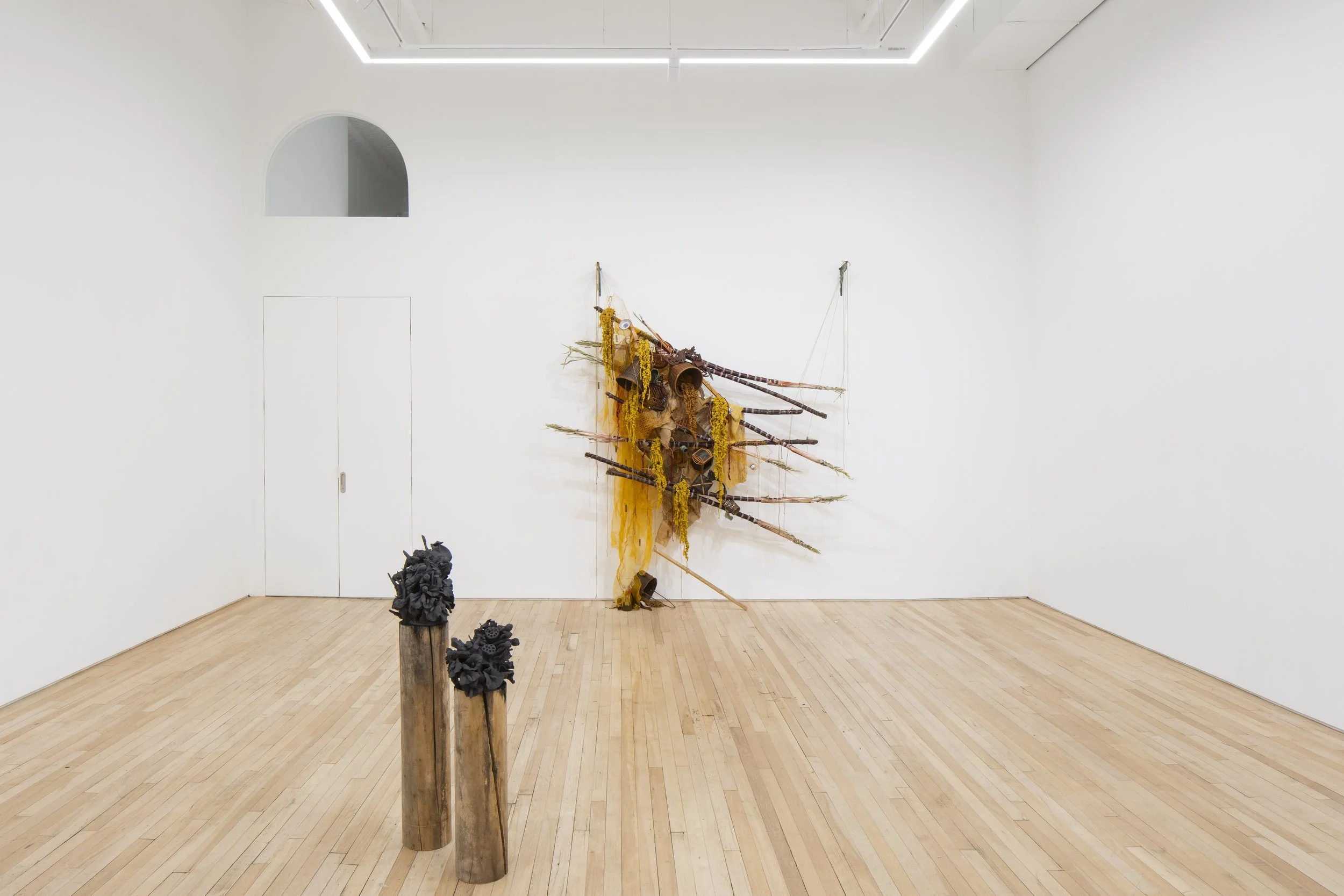
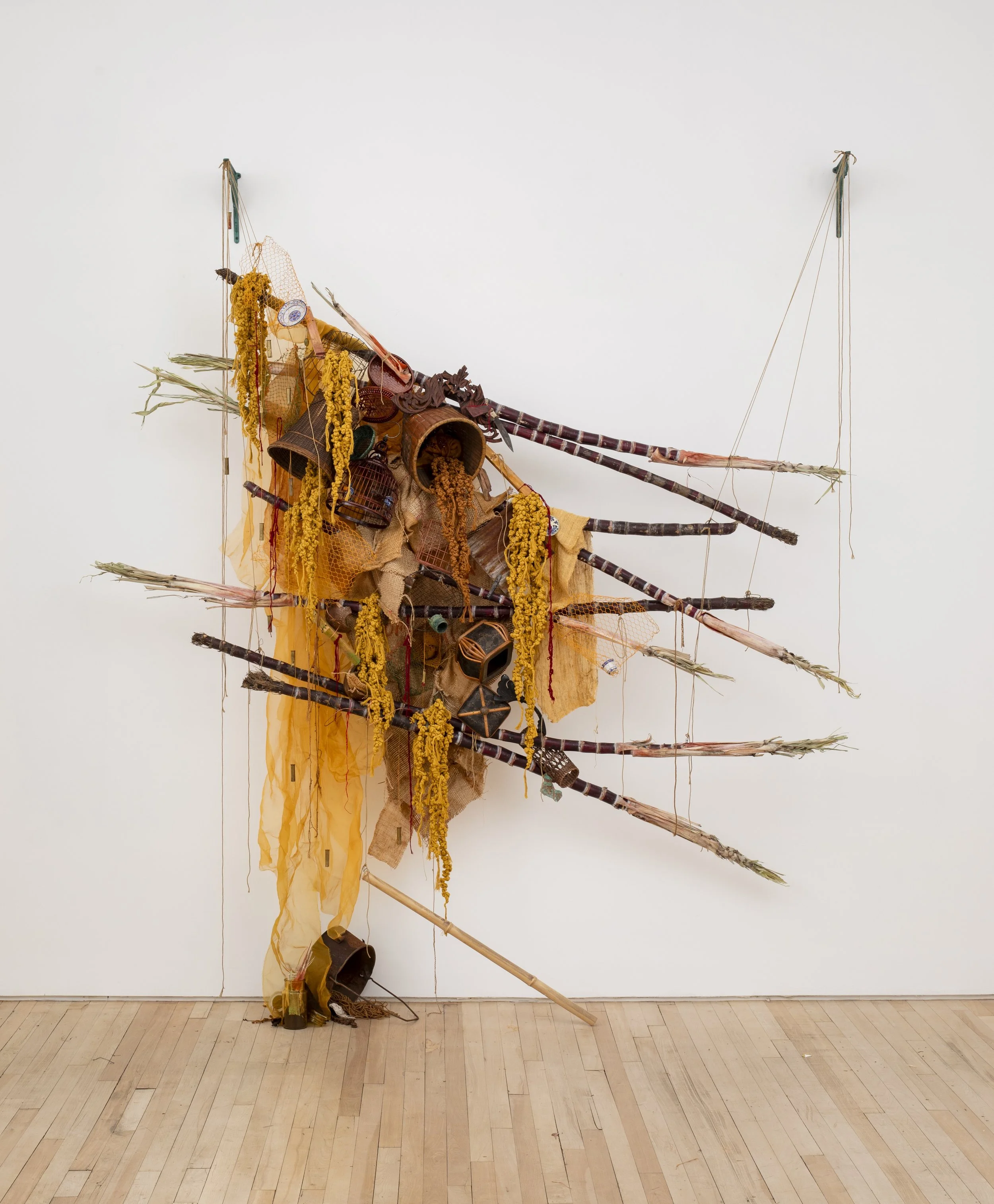
Amanda Phingbodhipakkiya, Where sugar bleeds, 2026, Sugarcane, hand-dyed silk, woven silk, cotton cord, copper, bamboo, reclaimed vessels, porcelain, shell casings, oyster shells, thread, beads, wire, sewn coffee and grain sacks, wood, 80 x 75 x 24 in.
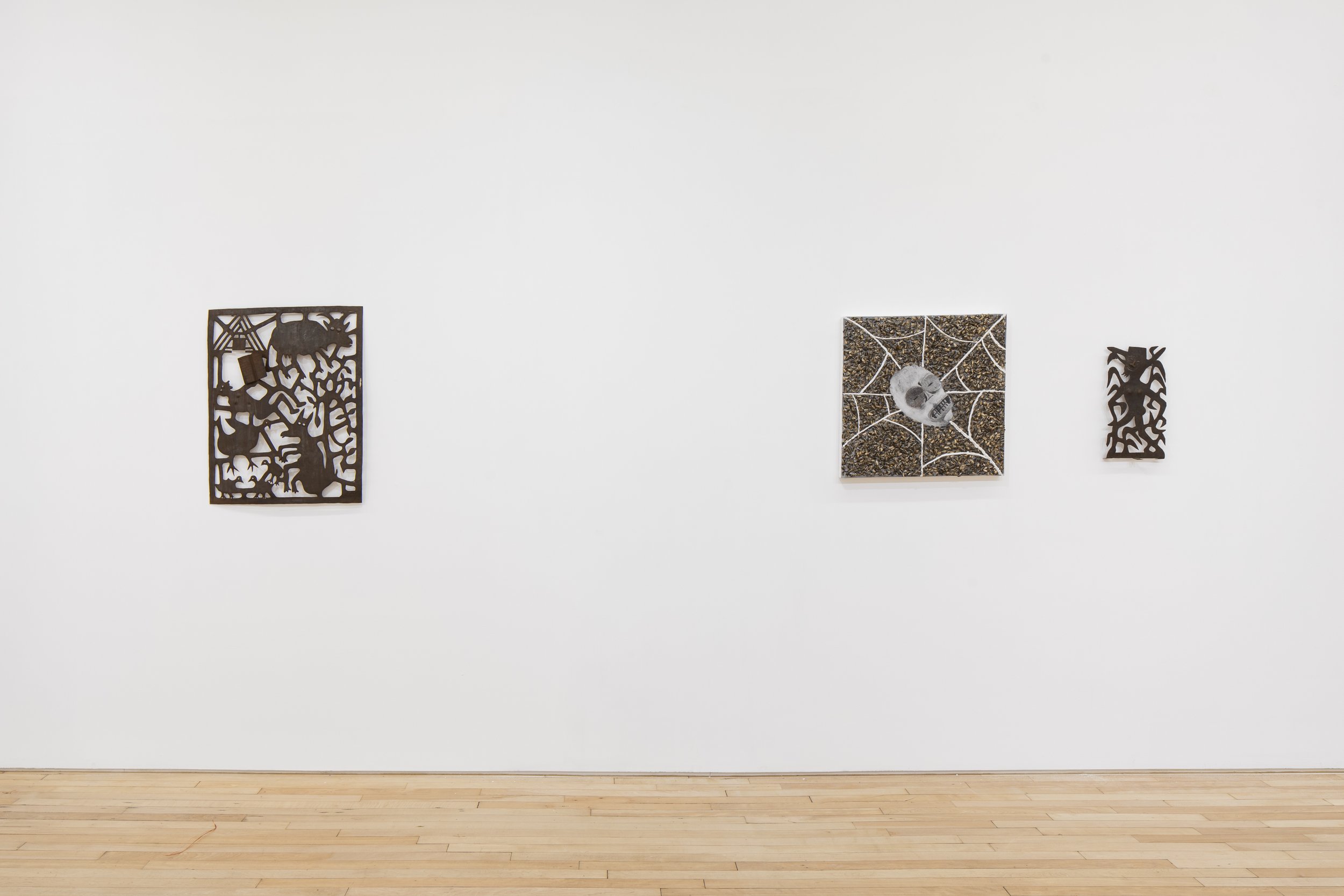
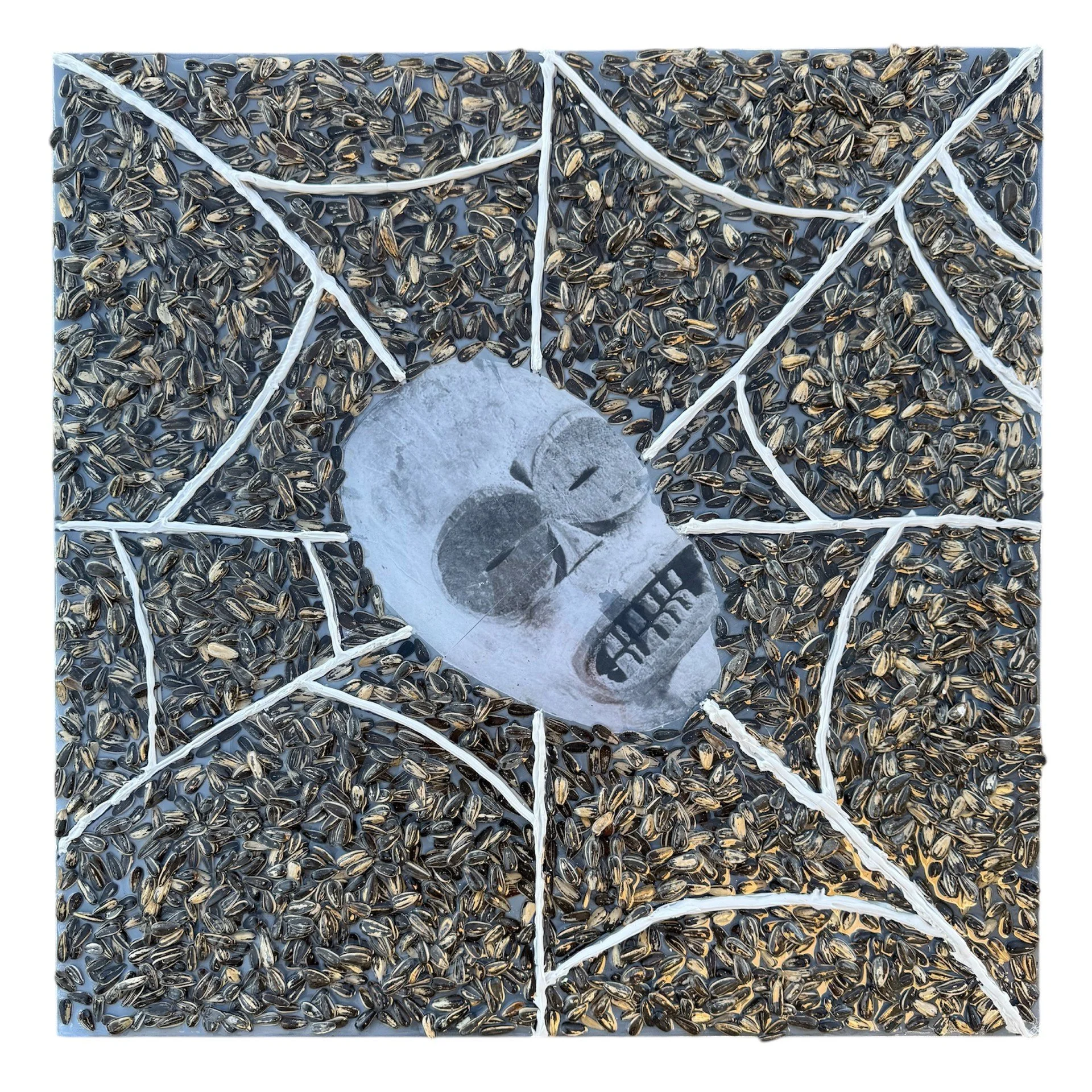
Emmanuel Massillon, Webbed Fractals, 2026, Sunflower Seeds, Salt, Acrylic Paint, Jet Ink Print, Resin on Canvas, 20 x 20 in.
Bounty
-
Lindsay Adams (b. 1990, Washington, D.C.) is a writer and painter working across traditional mediums. Employing her educational foundation as a social scientist, with a background in foreign relations, sociology, and cultural anthropology, she systematically engages in her work with precise critical analysis and a perceptive understanding of the complex fabric of social dynamics. Lindsay received her B.A.s in both International Studies: World Politics and Diplomacy and Spanish from the University of Richmond and an MFA in Painting and Drawing from the School of the Art Institute of Chicago.
-
Baseera Khan (b. 1980, Denton, TX) is a New York-based visual artist interested in materials, color, and their economies. From public art installation to sculpture, painting to performance and music, Khan collages the effects of these relationships to labor and family structures, religion, and spiritual well-being.
-
Georges Liautaud (b. 1899, Croix de Bouquets, Haiti) was an emblematic artist, credited with originating the craft of Haitian metal-working. Originally a blacksmith, he crafted mechanical parts and crosses for cemeteries. In the 1940s, he began sculpting with empty oil drums, developing the craft of Haitian cut-metals. These early works were noticed by U.S. artist Dewitt Peters, the founder of Le Centre d’Art, and included in Selden Rodom’s book Renaissance in Haiti. Liautaud went on to represent his country in multiple international exhibitions, most notably the famous “Les Magiciens de la terre (The Magicians of Earth)” at the Centre Georges Pompidou.
-
Janvier Louis-Juste (b. 20th century, Croix Des-Bouquets) was a Haitian artist. With his two brothers, Seresier and Joseph, he learned the craft of Haitian cut-metals under Georges Liautaud. In 1968, he and his brothers joined Le Centre d’Art and would later pass down the art form to the next generation of Croix-des-Bouquets artists—notably Gabriel Bien-Aimé and Serge Jolimeau. His work is held in various museum collections, such as the Lowe Art Museum, Miami, FL; the Figge Art Museum, Davenport IA; the Spencer Museum of Art, Lawrence, KS; and the SFO Museum, San Francisco, CA.
-
Abigail Lucien (b. 1992, Dallas, TX) is a Haitian-American interdisciplinary artist. Working across sculpture, writing, and time-based media, their practice addresses themes of (be)longing, futurity, myth, and place by considering our relationship to inherited colonial structures and systems of belief/care. Implicating our relationship to material and place through an architectural vernacular, Lucien uses formal poetics to ponder concepts such as loss, love, and grief as fluid processions rather than states to reach or become.
-
Emmanuel Massillon (b. 1998, Washington D.C.) is a conceptual artist whose multidisciplinary practice spans painting, performance, sound, and sculpture. His work critically examines race, identity, and culture, particularly as they relate to people of African descent. Growing up in Washington D.C.’s inner city, Massillon’s experiences shape his artistic lens, challenging conventional narratives and offering fresh perspectives on everyday life and politically charged subjects. His work serves as both a critique and a celebration—interrogating power structures while amplifying the resilience, ingenuity, and creativity found within marginalized communities.
-
Rithika Merchant (b. 1986, Bombay (Mumbai), India) is a visual artist from Bombay (Mumbai), India. Her work explores both comparative mythology as well as science and speculative fiction, featuring creatures and symbolism that are part of her personal visual vocabulary. She creates bodies of work that visually link to our collective past as well as imagine possible new worlds which we may come to inhabit.
-
Damien Paul (b. 1941, Drouillard, Haiti) resides and works in Florida. A self taught artist, he began metal-working with Janiver Louis Juste and in 1969, joined Le Centre d’Art. With painting and sculpture, Paul explores scenes of everyday Haitian life and voodoo. Paul has been exhibited in the Brooklyn Museum, Brooklyn, NY; the Davenport Museum, Savannah, GA; the Cheekwood Estates and Gardens, Nashville, TN; amongst others. His work is held in the permanent collections of the Milwaukee Art Museum, Milwaukee, WI; the Figge Art Museum, Davenport, IA; and Le Centre d’Art, Port-au-Prince, HT.
-
Amanda Phingbodhipakkiya (b. 1988, Atlanta, GA) is a Brooklyn-based transdisciplinary artist whose work spans textiles, sculpture, painting, and installation. Working through precarious amalgamations that hold ruptured inheritances, she creates sites of collective reckoning rooted in her Thai and Indonesian heritage. Phingbodhipakkiya employs materials such as hand-knotted rope, reclaimed textiles, talismans, and vessels to investigate themes of absence, displacement, and inherited trauma—transforming them into expressions of resilience, ritual, and repair. Her practice foregrounds the embodied knowledge of immigrant communities and the often-invisible labor of women, constructing liminal spaces where memory, touch, and materiality intersect.
-
Nyugen E. Smith (b. 1976, Jersey City, NJ) is a Caribbean-American interdisciplinary artist based in Jersey City, NJ, working across mixed media drawing, assemblage, and performance. His practice centers on world-building informed by ritual, memory, language, history, and art-making processes that prioritize reuse, the body, and play, all examined through the prism of Black cultural identity.
Bounty
January 28 – February 28, 2026
BOUNTY explores the evolving relationship between people and natural resources through cycles of extraction and regeneration. Through practices spanning geographies and generations, BOUNTY bears witness to an eco-human continuum shaped by modes of engagement that range from stewardship to exhaustion.
The exhibition is inspired in part by the regenerative work of Grown in Haiti, a reforestation organization based in the mountains of Jacmel. Founded on land once depleted by oil rigging and monocropping, the project has restored soil health and water access to cultivate and distribute more than 20,000 trees representing over 200 fruit-bearing species historically native to Haiti. This connection is further shaped by curator Sadaf Padder’s long-standing involvement with the organization as a volunteer since 2019.
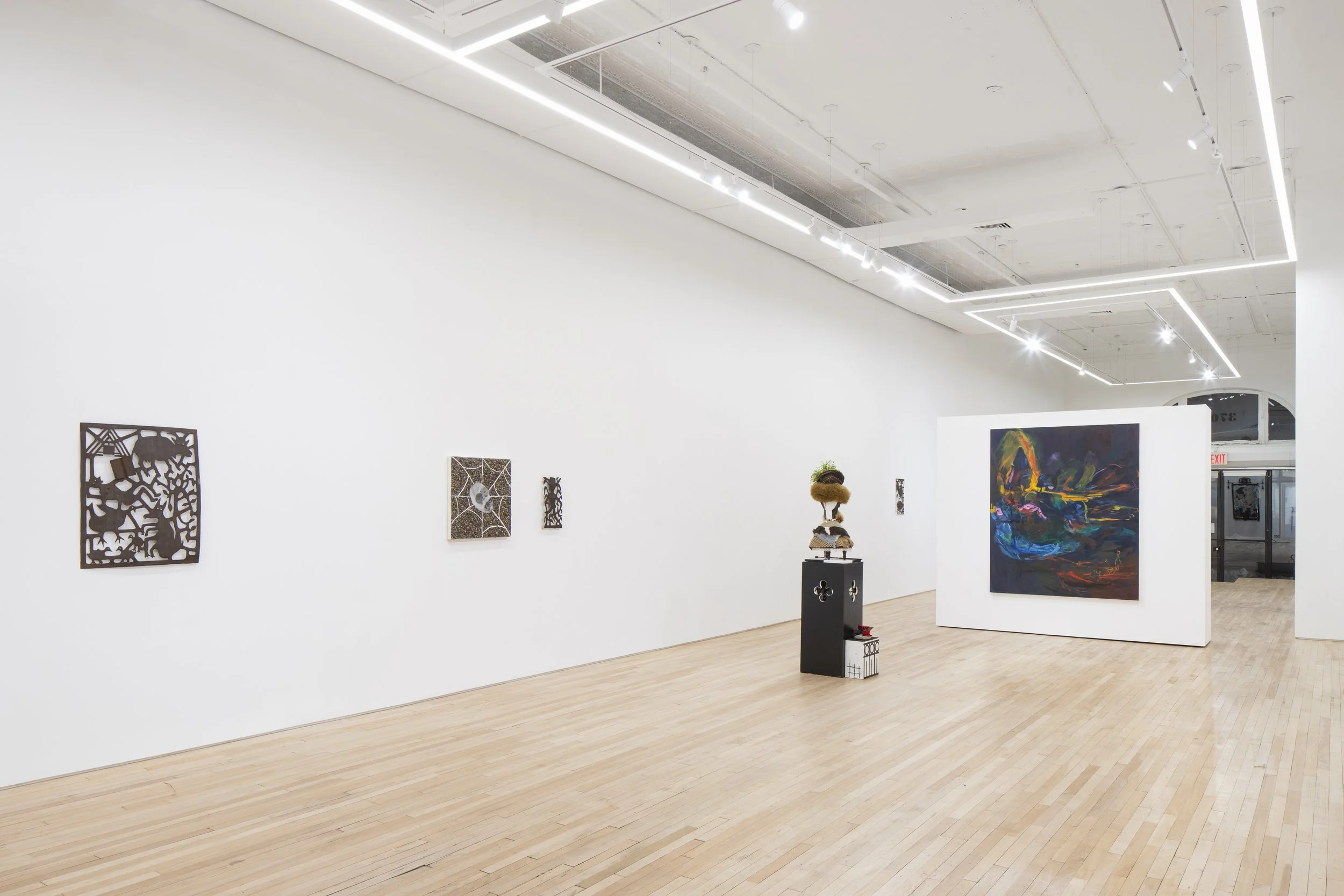
BOUNTY is also informed by Sargent’s Daughters owner and director Allegra LaViola’s family collection, inherited from her late father, Alex Pagel, whose deep engagement with Haitian art laid the foundation for the exhibition. Works by Georges Liautaud, Janvier Louis-Juste, and Damien Paul—created in the mid-1950s and fashioned from discarded steel oil drums—exemplify the tradition of Haitian metal sculpture, transforming industrial remnants into intricate reliefs and sculptural forms depicting daily life and sacred iconography. These works anchor the exhibition in a lineage of respect and inheritance.
Extending outward from Haiti, the exhibition brings together artists working across the Caribbean, African, and Asian diasporas who reflect on related histories of human interventions that have altered ecological systems. Material inquiries engage reclaimed or natural substances shaped by depletion and reuse, reanimating matter and species marked by exploitation. Abstract investigations hold scarcity and excess in visual tension. Speculative imaginaries envision futures populated by hybrid beings and reconfigured ecosystems, where coexistence and balance guide new forms of life. Together, these practices articulate regeneration as an active and imaginative process.
Even within compromised systems, regeneration persists. In 1839, Haitian poet and storyteller Ignace Nau envisioned Haiti as a site of ecological rebirth alongside political emancipation, anticipating restoration as both environmental and cultural renewal. In a lyrical tribute to a newly liberated homeland and founding father Jean-Jacques Dessalines, Nau writes:
“The voice of our forests will become sound again,
And our rivers will flow out in torrents,
And our lakes will roll more transparent streams…”
These lines register an early recognition that colonial conquest and chattel slavery inflicted violence upon land as well as people, fracturing ecosystems and disrupting the flourishing of Haiti’s flora and non-human kin. As the world’s first free Black republic, Haiti emerged from a revolution that bound human liberation to the devastation of its environment, rendering ecological destruction inseparable from histories of racialized violence and human suffering. In imagining national restoration, Nau thus understood regeneration not merely as political recovery but as the return of ecological balance, in which the repair of land and the healing of a formerly enslaved people were deeply entangled.
That vision continues to resonate. On a mountaintop in Haiti, jackfruit, soursop, sugarcane, plantains, mango, and breadfruit flourish, drawing nourishment from restored soil and flowing water. These harvests sustain surrounding communities in a bio-diverse system shaped by mutual reliance shaped through collective responsibility. Across oceans, in studios from Brooklyn to Washington, DC, to Mumbai, artists work in conversation with this living rhythm, translating the pressures and possibilities of the present ecological moment. BOUNTY holds open a space where regeneration is felt as a living and evolving practice carried between land and body, memory and matter.